How to Compare Scrap Gold Offers Using Melt Value and Buyer Deductions
Calculate scrap gold melt value from weight and karat, then compare two buyer offers after testing fees, weight adjustments and other deductions.
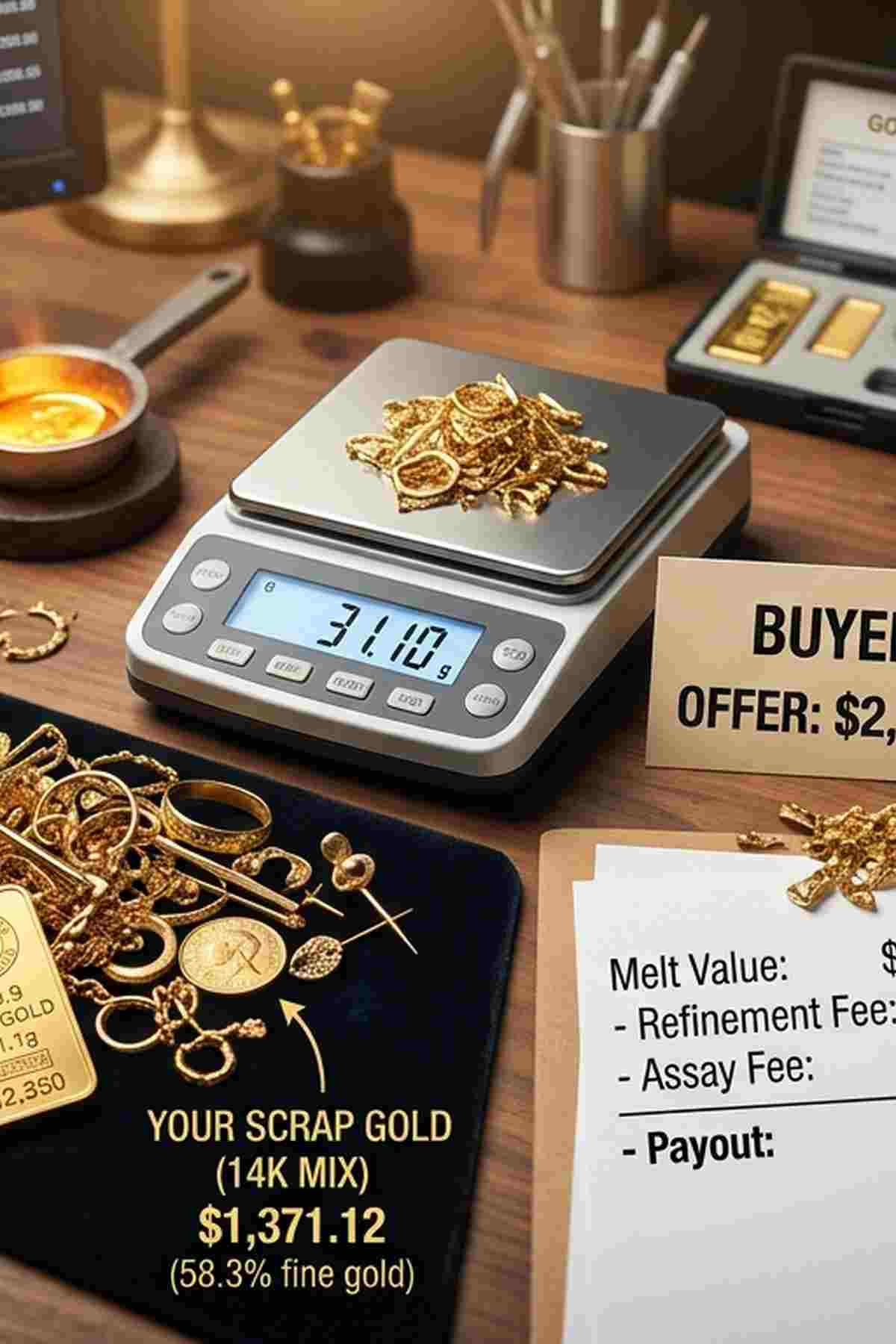
A broken chain can attract two very different cash offers within the same afternoon. One buyer quotes a generous percentage. Another names a smaller percentage but promises no extra charges. Neither figure tells you enough until you know what your gold contains and how much money you will actually receive.
You can put both offers on the same footing with a few calculations. Start with the weight of the gold alloy, account for its purity, and calculate its theoretical melt value. Then divide each buyer’s final payout by that value. The result shows how much of your gold’s benchmark value reaches your pocket.
Three Numbers That Put You in Control
- Calculate melt value from eligible metal weight, purity and a matching gold benchmark.
- Subtract every charge before comparing buyer payouts.
- Express each final offer as a percentage of the same melt value.
Give Your Broken Jewellery a Clear Starting Weight
Imagine you have a broken 18-karat bracelet and a damaged 9-karat ring. Their combined scale weight is 19 grams. The ring still contains a stone, and the bracelet has a small non-gold component.
For this worked example, a buyer separates and weighs those excluded components with your agreement. They total 1 gram. Your remaining gold alloy weighs 18 grams: 12 grams from the bracelet and 6 grams from the ring.
That distinction matters. The original 19 grams was the weight of everything on the scale. The remaining 18 grams is the metal weight used in your calculation. Neither number is the weight of pure gold.
A kitchen scale may help you make an early estimate, but its rounding can make a meaningful difference on small items. Ask the buyer to show the scale reading and record each purity group separately. Avoid accepting a single combined weight for pieces with different karats.
Before anyone removes stones or cuts a piece for testing, agree on the procedure. A damaged item can still have resale or repair value. Check that possibility before authorising work that could reduce it.
Turn Karat Marks Into Pure Gold Content
Karat describes gold content in twenty-four parts. Divide the karat number by 24 to estimate the gold fraction. An 18-karat piece has a gold fraction of 18 ÷ 24, or 0.75. A 9-karat piece has a fraction of 9 ÷ 24, or 0.375.
Fineness marks express purity in parts per thousand. A 750 mark represents 75% gold, while 375 represents 37.5%. UK government hallmarking guidance uses this parts-per-thousand system. A small stamp is useful evidence, but an uncertain or suspicious item still needs testing.
Apply the appropriate fraction to each item’s eligible metal weight:
Bracelet: 12 g × 0.75 = 9 g of pure gold.
Ring: 6 g × 0.375 = 2.25 g of pure gold.
Total pure gold content: 9 g + 2.25 g = 11.25 g.
Your 18 grams of jewellery alloy therefore contains an estimated 11.25 grams of pure gold. The other 6.75 grams consists of alloying metals. You have already allowed for those metals through the purity calculation. A buyer should explain any further adjustment rather than deducting that alloy content a second time.
For pieces marked 585, use 0.585 when calculating from the stated fineness. Dividing 14 by 24 gives a slightly different fraction. Record which basis you use and ask the buyer which purity their offer assumes.
Convert the Gold Benchmark Into Melt Value
Use a quoted gold price as the starting benchmark, checking its currency, unit and timestamp. Your comparison works only when both offers use a consistent reference. A dollar quote per troy ounce cannot go straight into a calculation using grams.
One troy ounce equals 31.1034768 grams, as documented in NIST’s Precious Metals Conversion Information. This differs from the ordinary ounce used for many household goods. Using the wrong ounce conversion will distort your estimate.
For easy arithmetic, assume a hypothetical benchmark of $3,110.34768 per troy ounce. This is an illustration, not a statement of today’s market price.
Pure gold price per gram: $3,110.34768 ÷ 31.1034768 = $100.
Estimated melt value: 11.25 g × $100 = $1,125.
You can check the total by calculating each piece separately. The bracelet contributes 12 × 0.75 × $100 = $900. The ring contributes 6 × 0.375 × $100 = $225. Added together, they produce the same $1,125 benchmark.
The complete formula is:
Melt value = eligible metal weight in grams × gold purity fraction × pure gold price per gram.
Melt value describes the theoretical value of the contained gold at your chosen benchmark. It does not promise a retail buyer will pay that amount. Buyers need room for processing costs, price exposure and profit. Your task is to measure the total gap and understand the terms behind it.
Compare Two Offers After Every Deduction
Now suppose two buyers assess the same items, accept the same weights and purities, and use the same $1,125 melt value.
Buyer A advertises 92% of melt value. That produces an initial amount of $1,035. The written quote then subtracts a $30 testing fee and a $25 processing charge. Your final payout is $980.
Buyer B offers 89% of melt value with no additional charges. Your final payout is $1,001.25.
Two Buyer Offers Against the Same $1,125 Melt Value
| Offer Detail | Buyer A | Buyer B |
|---|---|---|
| Estimated melt value | $1,125.00 | $1,125.00 |
| Quoted payout percentage | 92% | 89% |
| Amount before separate fees | $1,035.00 | $1,001.25 |
| Separate fees | $55.00 | $0.00 |
| Final payout | $980.00 | $1,001.25 |
| Final payout as a percentage of melt | 87.11% | 89.00% |
Buyer B pays $21.25 more despite quoting a lower initial percentage. Calculate the effective percentage yourself:
Effective payout percentage = final payout ÷ melt value × 100.
For Buyer A, $980 ÷ $1,125 × 100 = 87.11%, rounded to two decimal places. For Buyer B, $1,001.25 ÷ $1,125 × 100 = 89%.
The total gap from melt value is $145 for Buyer A and $123.75 for Buyer B. Those gaps include the buyers’ percentage discounts and any separate fees. They are not necessarily itemised processing costs or pure profit.
Check Whether Deductions Change Weight, Purity or Cash
Deductions can enter a quote at different stages. Removing a stone changes eligible weight. A test result can change the accepted purity. A testing charge reduces the cash payable. Keep these adjustments separate so you can follow the calculation.
In our example, the 1 gram of excluded components was removed before calculating melt value. Deducting its value again from the payout would count the same exclusion twice. Ask for the gross weight, excluded weight and payable metal weight in writing.
If a test suggests a lower purity than the stamp, ask which piece was tested and how the result affected its valuation. Pieces in a mixed lot can have different compositions. Ask whether further testing is available before accepting a substantial reduction.
Use these questions to make the final quote clear:
- What weight and purity are you accepting for each item?
- Which components have been excluded, and how was their weight established?
- What benchmark price, currency and timestamp does this quote use?
- Are testing, refining, handling, postage or payment charges still payable?
- What exact amount will I receive if I accept?
- What happens to my items, and what costs apply, if I decline?
A fee does not automatically make an offer poor. Its effect depends on the final payout. A clearly disclosed testing charge may still accompany the strongest offer. An unexplained charge makes the comparison harder and deserves an answer before you proceed.
Keep Different Quotes on a Consistent Basis
If one buyer quotes per gram and another uses pennyweight, convert the units before comparing rates. One pennyweight equals 1.55517384 grams. A larger price per pennyweight can look attractive simply because a pennyweight is heavier than a gram.
Also establish whether a quoted gram rate applies to pure gold or to a particular jewellery purity. In this example, pure gold is worth $100 per gram at the assumed benchmark. The theoretical melt value of 18-karat alloy is $75 per gram. For 9-karat alloy, it is $37.50 per gram.
Price timing matters too. If offers arrive on different days, a market move may explain part of the difference. For a clean comparison, request quotes close together and note when each expires. Keep your original benchmark visible if you want to compare both cash offers against the same reference.
Gold-filled jewellery and uncertain dental alloys need a separate assessment. Applying a solid-gold karat fraction to their entire weight can produce a misleading estimate. Leave uncertain items outside your main calculation until their composition is established.
Take the Offer You Can Account For
Your strongest negotiating tool is a calculation you can explain. In this example, 18 grams of eligible jewellery alloy contains 11.25 grams of pure gold. At the hypothetical $100-per-gram benchmark, that creates a melt value of $1,125.
Buyer A leaves you with $980, or 87.11% of that value. Buyer B leaves you with $1,001.25, or 89%. With the other terms held constant, Buyer B provides the better cash result.
Carry your weights, purity assumptions and benchmark into each conversation. Ask for a written final payout before handing over ownership. Once every deduction has a clear place in the calculation, you can judge an offer by the money you receive and the terms you accept.
More in this guide
Convert a Gold Offer From Pesos to DollarsScrap Gold Calculator.